Who It Is For
This major is designed for professionals and leaders in organisations that work with trauma-affected individuals, whānau, or communities.
Organisational Practice
Develop a deeper understanding of trauma’s impact on organisations and how systems, structures, culture, and leadership can support trauma-responsive practice.
Leadership and Service
Explore approaches to leadership, mentoring, supervision, and service development within trauma-informed professional contexts.
Culturally Attuned Learning
The curriculum integrates mātauranga Māori, honours Te Tiriti o Waitangi, and encourages culturally responsive organisational leadership and service.
Faith-Informed Education
Explore how faith, spirituality, ethics, and whole-person understanding can inform compassionate and responsible leadership.
Flexible Learning
The programme has used online learning and wānanga to support professionals studying from New Zealand and overseas. Confirm the specific 2027 attendance requirements with BTI.
Programme Overview
Trauma-informed organisational leadership and serviceThe Trauma-Informed Leadership and Service major develops a deeper understanding of how trauma affects people, teams, organisations, services, and communities.
Students explore how leadership, workplace culture, policy, supervision, mentoring, organisational systems, and professional practice can foster environments characterised by compassion, safety, trust, support, and responsiveness.
The programme integrates theoretical knowledge, personal reflection, professional experience, cultural responsiveness, and faith-informed perspectives within each student’s vocational context.
Study Pathway
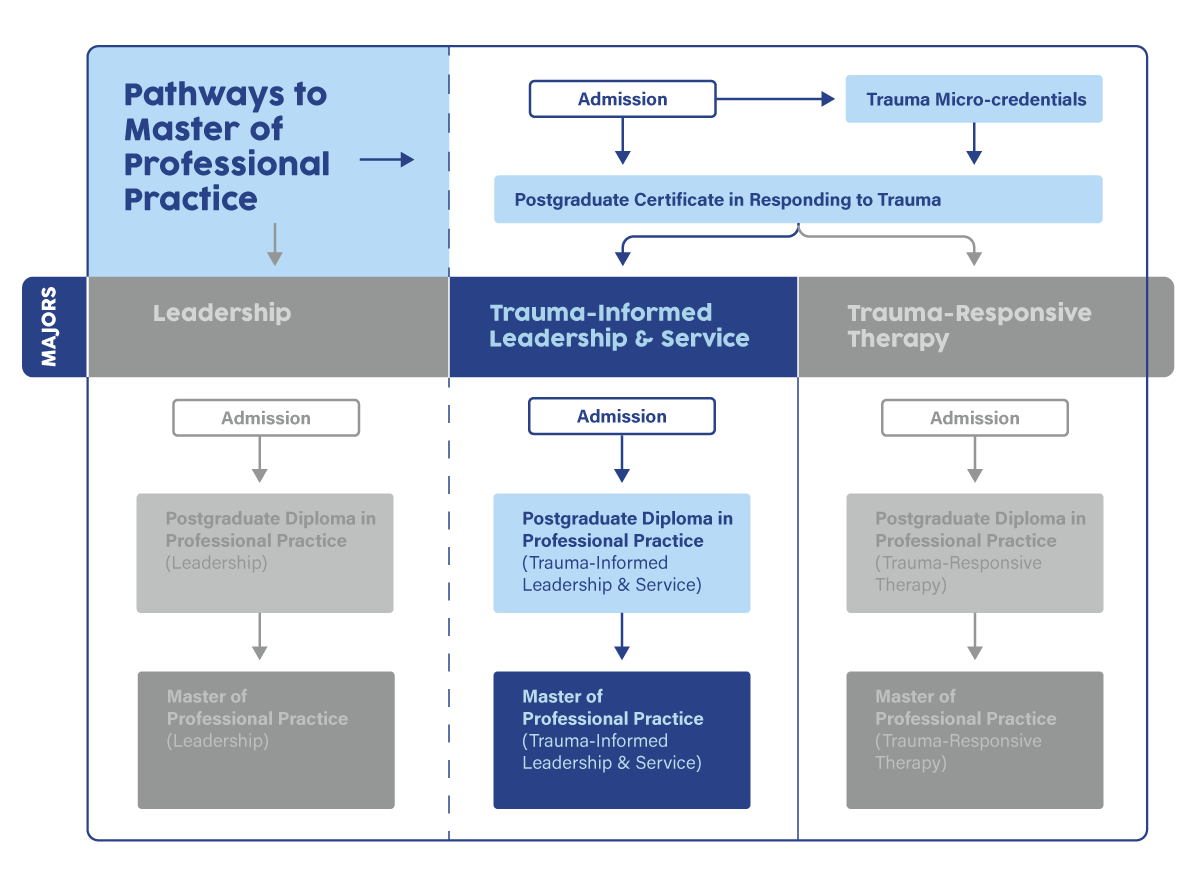
Confirm the 2027 sequence before applyingThe published pathway has required students to begin with the Postgraduate Certificate in Responding to Trauma, progress into the Trauma-Informed Leadership and Service major within the Postgraduate Diploma in Professional Practice, and then progress into the Master of Professional Practice.
Postgraduate Certificate
The published pathway begins with the Postgraduate Certificate in Responding to Trauma.
Postgraduate Diploma
Students then progress into the Trauma-Informed Leadership and Service major within the Postgraduate Diploma in Professional Practice.
Master’s Study
The Postgraduate Diploma pathway can lead into the Master of Professional Practice.
BTI’s Distinctive Approach
Integrating theoretical, personal, and professional learningUnique Approach
At BTI, we recognise that professional leadership engages with the spiritual dimension as well as the social and physical dimensions of people’s lives and workplaces.
The integration of theoretical, personal, spiritual, and professional learning is a distinctive feature of BTI’s Postgraduate Diploma and Master of Professional Practice study.
Integrating the Professional with the Personal
A key component of the programme is developing awareness of the gifts, talents, strengths, limitations, assumptions, and ways of thinking that influence each leader’s way of being.
Students bring existing literature, personal experience, the biblical narrative, and their own professional context into dialogue, allowing each to inform the others.
These cycles of critical reflection create opportunities to question societal, cultural, organisational, and institutional norms and examine the assumptions and values influencing leadership and service.
Leadership, Mentoring and Supervision
Supporting trauma-responsive organisational environmentsStudents explore how leaders can help create compassionate, safe, supportive, and accountable environments for staff, service users, and communities affected by trauma.
- Trauma-responsive organisational culture
- Ethical and reflective leadership
- Mentoring and professional supervision
- Staff wellbeing and sustainable practice
- Service development and organisational change
- Culturally responsive leadership
- Critical reflection on systems, power, and institutional norms
Entry Requirements
Requirements currently published by BTIProspective students should confirm the requirements for their intended qualification and entry point with the programme leader. Published requirements include:
- An interview with the programme leader
- An NZQA-approved Level 7 bachelor’s degree or equivalent
- Professional membership within a relevant field
- Completion of the required preceding qualification for entry into the Postgraduate Diploma or Master’s pathway
- An appropriate professional or vocational context in which learning can be applied
International Applicants
- Qualifications completed overseas may require an International Qualification Assessment.
- Published English-language requirements are equivalent to IELTS Academic 6.5, with no band score below 6.0.
- International applicants should confirm current qualification, English-language, delivery, and attendance requirements before applying.
Graduate Profile and Career Development
Strengthening leadership within professional contextsPostgraduate study in Trauma-Informed Leadership and Service can strengthen a professional’s knowledge of trauma-responsive organisations, reflective leadership, mentoring, supervision, cultural responsiveness, and organisational change.
Graduates may use this learning to strengthen their leadership within an existing professional field or support progression into an allied leadership, service-development, supervision, management, or organisational-development role.
Career progression will depend on a graduate’s existing qualification, professional membership, experience, employment context, and the requirements of individual roles and sectors.
Programme Resources
Reference information and feesThe available programme booklet is dated November 2024. It can be used as background information, but applicants should not rely on it for 2027 dates, availability, fees, or application requirements.
“I have experienced MPPL not just as a master’s degree or new learning of information, but as a journey into deep transformation – spiritual, physical, emotional, and professional – and the journey continues.”Philippa Becker, teacher and MPPL student
“I initially went into the master’s programme unsure of whether I could complete it, but through the gentle nurturing and support I received from the teachers, I was able to complete my degree.”John Wilson, teacher and MPPL graduate
“I knew that God had called me to complete the MPPL at this time in my life, and knowing that gave me the drive and passion to persevere.”John Wilson, teacher and MPPL graduate
Discuss Trauma-Informed Leadership Study
Contact Dr Lindsay Fish to discuss the programme, confirm the 2027 pathway, and determine whether this major is appropriate for your professional context.
Enquire About 2027 Study Ask About Application Documents